

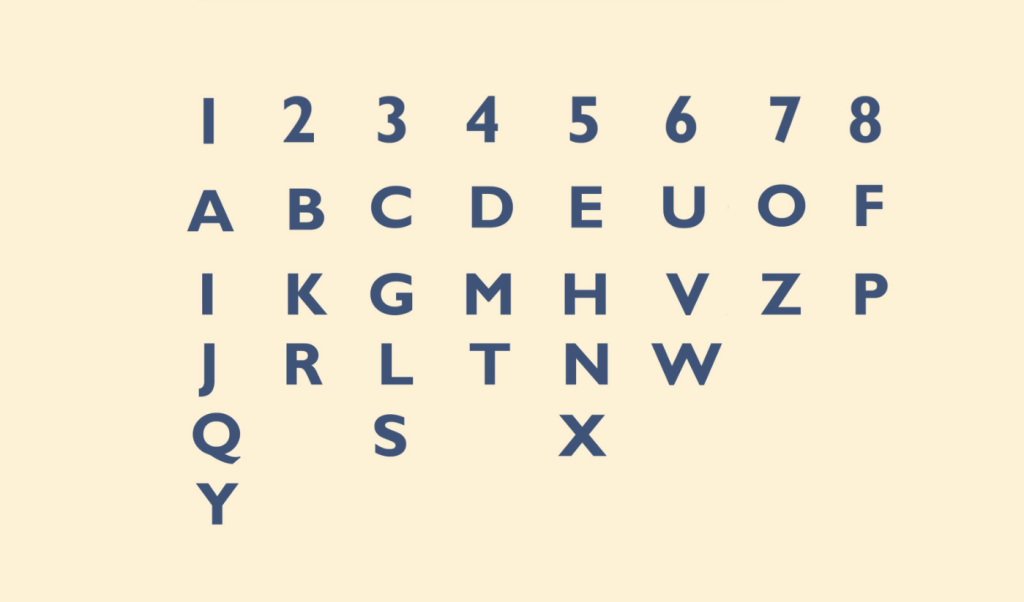
Chaldean Numerology Uses a Different Letter Chart
Modern Chaldean numerology assigns letters to numbers 1 through 8, adds the values in a selected name and may interpret both the compound total and its reduced root number.
The system is spiritual and symbolic. Its historical origin, calculation conventions and name rules vary, so a responsible guide shows the chart, explains the method and avoids promising fate or personality certainty.
Common Chaldean Letter Chart
1
A, I, J, Q, Y
2
B, K, R
3
C, G, L, S
4
D, M, T
5
E, H, N, X
6
U, V, W
7
O, Z
8
F, P
The number 9 is usually not assigned directly to letters in this common chart, but it can still appear in a total.
What Chaldean Numerology Is
Chaldean numerology is a name-number system commonly presented as an alternative to the modern Pythagorean chart. It places greater emphasis on sound, compound totals and the form of the name used in daily life.
Historical claims that the modern chart is an unchanged ancient Chaldean system are difficult to verify. Describing it as a modern numerology tradition called Chaldean is more accurate than presenting every current rule as established ancient history.
Five-Step Calculation Method
Choose Name
State whether you use a birth, legal, current or everyday name.
Remove Marks
Apply a stated rule for spaces, punctuation and accents.
Assign Values
Use one Chaldean chart consistently.
Add Total
Preserve the compound number before reduction.
Reduce
Add the digits to find the root number if the method calls for it.
Calculation Example: ANNA
Using the chart above:
- A = 1
- N = 5
- N = 5
- A = 1
- Total = 12
- Reduced root = 1 + 2 = 3
A practitioner may discuss both 12 and 3. The interpretation is symbolic and does not establish personality, ability or destiny.
Compound and Root Numbers
A compound number is the total before reduction. In the example above, 12 is the compound number and 3 is the root. Different books attach different meanings to compound numbers, which can create conflicting readings.
- Record the compound number before reducing.
- Name the source or convention used for its meaning.
- Do not combine descriptions from incompatible systems without explanation.
- Avoid treating a difficult-sounding compound number as a curse or punishment.
Why Number 9 Is Treated Differently
In the commonly used Chaldean letter chart, 9 is not assigned directly to letters and is often given special spiritual symbolism. This does not mean that 9 is forbidden or impossible.
A name total can equal 9, 18, 27 or another number that reduces to 9. The chart rule concerns direct letter assignment, not every possible calculation result.
Which Name Should You Use?
Practitioners disagree. Common choices include:
- Full birth name
- Current legal name
- Married name
- Professional name
- Nickname or everyday spoken name
A transparent reading states which name was used and why. It can compare more than one version without claiming that one number controls the person.
Chaldean Versus Pythagorean Numerology
| Feature | Chaldean | Pythagorean |
|---|---|---|
| Letter values | Commonly 1 through 8 | Cycles alphabet through 1 through 9 |
| Number 9 | Usually not assigned directly to letters | Assigned to I and R in the common chart |
| Name emphasis | Often current or spoken name | Often full birth name |
| Compound totals | Frequently emphasized | Often reduced more quickly |
| Result | Different total for many names | Different total for many names |
Read the broader Numerology Guide: Core Numbers, Methods and Limits before combining systems.
Handling Accents and Non-Latin Alphabets
Most published charts are designed for Latin letters. A name containing accents or another script requires a clear transliteration rule.
- Preserve the original spelling in your records.
- State the transliteration or substitution used.
- Do not claim that one English spelling reveals a culturally universal number.
- Respect a person’s chosen name and language.
Changing a Name
Changing a name changes a name-based total within the chosen system. It does not prove that personality, luck, health, business or destiny changed.
Legal and professional name changes have practical consequences involving identity documents, contracts, reputation and privacy. Those consequences should be considered directly rather than reduced to numerology.
Using the Result as Reflection
Turn a symbolic number into a question instead of a verdict. For a root number 3, for example, a practitioner might ask:
- Where do I communicate clearly?
- Which creative idea needs consistent work?
- When does expression become avoidance?
- What feedback would help me improve?
The questions remain useful only when compared with real behavior and circumstances.
Business and Relationship Name Claims
Some services promise that a name spelling will guarantee profit, marriage, fame or compatibility. Numerology cannot establish those outcomes.
- Use contracts, market research and qualified advice for business decisions.
- Use communication, consent and observed behavior for relationships.
- Do not pay escalating fees to correct a supposedly dangerous name.
- Do not discriminate against a person because of a name total.
What Chaldean Numerology Cannot Prove
- A fixed personality or hidden true self.
- Guaranteed success, wealth or marriage.
- A medical or mental-health condition.
- A curse, punishment or past-life debt.
- Whether a person is trustworthy or compatible.
- That changing a spelling changes fate.
Fear-based name correction and repeated payment pressure are warning signs.
Related Numerology Guides
Continue with Life Path Numbers, Karmic Debt Numbers and the Astrology and Numerology topic hub.
Frequently Asked Questions
1. What is Chaldean numerology?
It is a modern numerology system commonly associated with a 1-to-8 letter chart, compound numbers and reduced totals. It is a spiritual interpretation rather than a scientific test.
2. Is Chaldean numerology historically proven to come directly from ancient Chaldea?
Modern claims of direct, unchanged transmission are difficult to verify. It is safer to describe the chart as a modern system traditionally called Chaldean numerology.
3. Why are letters assigned only to 1 through 8?
In the commonly used chart, 9 is not assigned directly to letters because it receives special symbolic treatment. Nine can still appear in totals.
4. What name should I use?
Practitioners differ. Some use the everyday current name, while others compare birth, legal, married, professional or nickname forms. State the chosen rule.
5. What is a compound number?
It is the unreduced total, such as 12, 23 or 35, that some Chaldean practitioners interpret before reducing to a single digit.
6. Should I reduce every number immediately?
Not always. Many practitioners preserve the compound total and then note the reduced root number.
7. How is Chaldean numerology different from Pythagorean numerology?
The letter assignments and conventions differ. Chaldean commonly uses 1 through 8, while the Pythagorean chart cycles letters through 1 through 9.
8. Can the same name produce different results in the two systems?
Yes. Different letter assignments usually produce different totals, which is why systems should not be mixed.
9. Does changing a name change destiny?
It changes the calculation within a name-based system, but there is no proof that fate, personality or external outcomes change because of the number.
10. Can I use a nickname?
Some practitioners use the name spoken most often. Others prioritize a birth or legal name. The choice should be stated rather than hidden.
11. How are spaces, punctuation and accents handled?
Conventions vary. Most calculations ignore spaces and punctuation, while transliteration rules for accented or non-Latin letters should be explained.
12. Can Chaldean numerology predict marriage or business success?
No. It may provide symbolic prompts but cannot guarantee relationship, financial or professional outcomes.
13. Can it diagnose illness or mental health?
No. Numerology cannot diagnose a condition or replace qualified health care.
14. Is number 9 forbidden?
No. In the common chart it is not assigned directly to letters, but it may appear as a total or reduced result.
15. How should I use Chaldean numerology responsibly?
Show the chart and math, name the chosen form of the name, compare the interpretation with real behavior and avoid high-stakes predictions.
Editorial Note
The chart above reflects a commonly used modern Chaldean numerology convention. Historical lineage and calculation rules vary across sources. The method is presented as symbolic interpretation rather than scientific measurement.
See the Expert Psychics Editorial Policy.
Corrected and last reviewed: August 18, 2026.