

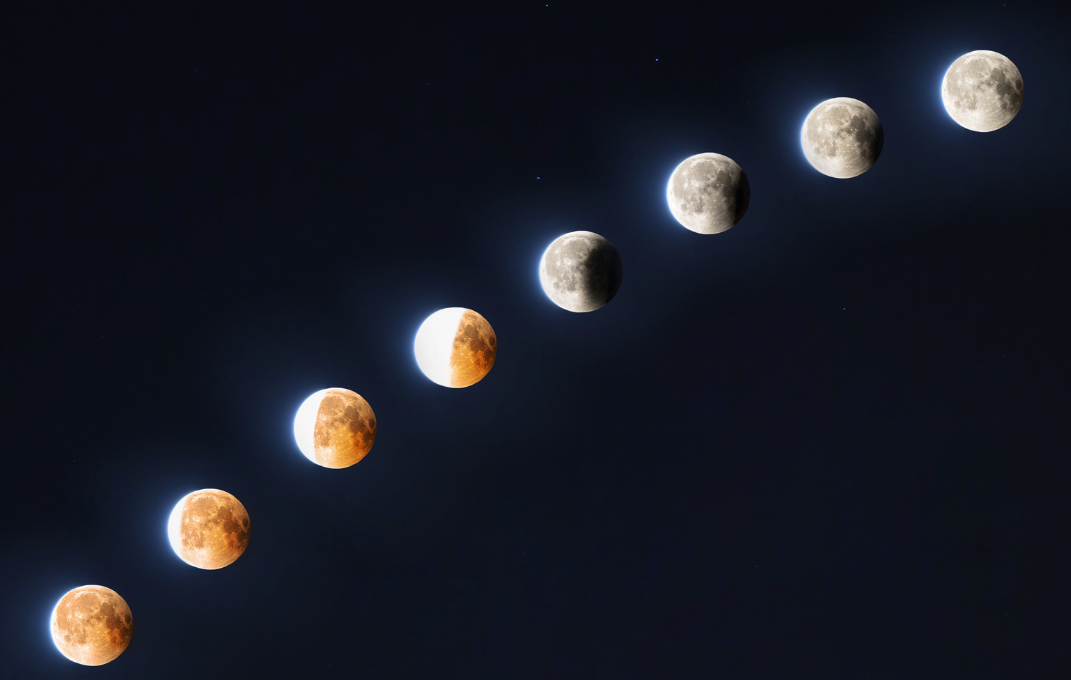
Moon phases are the changing views of the Moon’s sunlit half as the Moon orbits Earth. The cycle from one new Moon to the next takes about 29.5 days. The Moon’s gravity contributes to ocean tides, but research has not established that ordinary lunar phases broadly control human emotions, behavior or psychiatric health. Spiritual meanings assigned to each phase come from cultural and personal traditions rather than astronomy.
Science and symbolism can be separated: the phase itself is an astronomical event; meanings such as beginnings, release or heightened intuition are spiritual interpretations people may use for reflection.
What Causes the Phases of the Moon?
The Sun always illuminates half of the Moon. As the Moon travels around Earth, our viewing angle changes, so we see different portions of that illuminated half. The Moon is not producing its own light, and Earth’s shadow does not create the normal monthly phases. Earth’s shadow is involved only during a lunar eclipse.
The eight named phases repeat in a predictable order. The illuminated side can appear reversed depending on whether an observer is in the Northern or Southern Hemisphere, so descriptions based only on “left” or “right” are not universal.
The Eight Moon Phases
1. New Moon
The Moon is near the Sun in our sky, with its illuminated side mostly facing away from Earth. It is generally difficult to see.
2. Waxing Crescent
A thin illuminated crescent becomes visible and grows a little larger each evening.
3. First Quarter
The Moon is one-quarter of the way through its cycle, and we see half of its visible disk illuminated.
4. Waxing Gibbous
More than half of the visible disk is illuminated, and the bright portion continues to grow.
5. Full Moon
Earth is roughly between the Sun and Moon, allowing us to see nearly all of the Moon’s illuminated near side.
6. Waning Gibbous
More than half remains illuminated, but the bright portion appears to shrink from night to night.
7. Third or Last Quarter
The Moon is three-quarters of the way through its cycle, and half of its visible disk appears illuminated.
8. Waning Crescent
A thin crescent remains before the Moon returns to the new Moon position.
How the Moon Affects Tides
The Moon and Sun exert gravitational forces that help create ocean tides. Coastal areas commonly experience two high tides and two low tides during a lunar day, although local geography, ocean depth, coastline shape and weather influence the timing and height.
New and full Moons are associated with spring tides, when the Sun, Earth and Moon are approximately aligned and the tidal range is often larger. First- and third-quarter Moons are associated with neap tides, when the Sun and Moon pull at roughly right angles and the tidal range is often smaller.
Does a Full Moon Affect Mood or Behavior?
The belief that full Moons cause emotional intensity, psychiatric emergencies, unusual behavior or poor sleep is widespread. Large observational studies have generally found no meaningful population-level relationship between lunar phase and psychiatric admissions or emergency presentations. Research on sleep and other biological rhythms has produced mixed findings, and any effects reported in some studies are not evidence that the Moon controls an individual person’s mood.
Personal expectations can also shape what people notice. Someone who expects a full Moon to feel intense may remember a restless night that fits the belief and overlook ordinary nights that felt similar. Keeping dated records can help separate a repeated pattern from a memorable coincidence.
Traditional Spiritual Meanings of Moon Phases
Many spiritual, astrological, Pagan and contemporary wellness practices use the lunar cycle as a symbolic calendar. The following meanings are traditions, not scientific properties of moonlight:
- New Moon: beginnings, quiet reflection and choosing an intention
- Waxing Crescent: planning, hope and early action
- First Quarter: decisions, effort and working through resistance
- Waxing Gibbous: refinement, patience and preparing to complete a goal
- Full Moon: illumination, gratitude, celebration and honest review
- Waning Gibbous: sharing, integrating lessons and giving thanks
- Last Quarter: reassessment, forgiveness and releasing what is no longer useful
- Waning Crescent: rest, closure and preparation for a new cycle
A person can use these themes as journaling prompts without believing that a phase forces an event or emotion to occur.
What Does the Triple Moon Symbol Mean?
The Triple Moon symbol usually shows a waxing crescent, full Moon and waning crescent. In some modern Pagan and Wiccan traditions, the three forms are associated with the Maiden, Mother and Crone: symbolic stages connected with beginnings, fullness and wisdom. Interpretations vary among traditions and individuals, and the symbol should not be presented as having one universal meaning.
Simple and Safer Moon Rituals
New Moon: choose one intention
Write one goal that depends primarily on your own choices. Add one obstacle and one action you can take during the next week. Meditation, a quiet walk or holding a meaningful object may help you focus, but the practical action is what moves the goal forward.
Waxing Moon: build momentum
Review your intention and note what you have done. Choose the next small step rather than repeating an affirmation without action. A short daily check-in can be more useful than waiting for a dramatic sign.
Full Moon: review and appreciate
List what has changed, what remains unfinished and what you appreciate. Separate facts from hopes. A full-Moon practice can be a time to notice progress without claiming that moonlight caused it.
Waning Moon: release and simplify
Remove one commitment, object or habit that no longer supports your priorities. “Release” can mean setting a boundary, clearing a workspace or changing a plan rather than performing a dramatic ritual.
Candle and fire safety
Never leave a candle or burning paper unattended. Use a stable, heat-resistant surface, keep flames away from clothing and plants, and avoid outdoor burning where it is prohibited or unsafe. A written release ritual can be completed by tearing or recycling paper instead of burning it.
Crystals and moonlight
Some people place crystals near a window as a symbolic cleansing or charging practice. There is no scientific evidence that moonlight changes a crystal’s healing power. Treat the practice as personal ritual, and check whether a stone can fade, crack or react to moisture before placing it outdoors.
How to Keep a Moon Journal
- Record the date, Moon phase and location.
- Note sleep, mood and significant events without assuming a cause.
- Write the spiritual theme you chose for that phase.
- Track actions taken toward an intention.
- Review several months, including both matches and non-matches.
This approach allows room for spiritual meaning while reducing hindsight bias. It can also turn a lunar practice into a consistent reflection habit.
Frequently Asked Questions
Why does the Moon appear to change shape?
It does not physically change shape. We see different portions of its sunlit half as the Moon moves around Earth.
How long is a complete Moon-phase cycle?
The cycle from new Moon to new Moon is approximately 29.5 days.
Does the full Moon cause emotional behavior?
Research has not established a broad population-level effect on mood or psychiatric emergencies. Individual experiences may still feel meaningful, but they do not prove causation.
Are spiritual Moon meanings scientifically proven?
No. Meanings such as intention, abundance and release come from spiritual and cultural traditions rather than astronomy.
Can I practice a Moon ritual without believing in lunar energy?
Yes. The lunar cycle can simply provide a recurring schedule for journaling, reviewing goals, expressing gratitude and resting.
Final Perspective
The Moon’s phases are predictable astronomical changes with a measurable role in tidal patterns. Their spiritual meanings are symbolic frameworks people may use to organize reflection and ritual. Keeping those two layers distinct makes the subject more accurate without removing its personal or spiritual value.
Sources and Editorial Notes
- NASA: Moon Phases
- NOAA: How Tides Work
- Study of lunar phases and psychiatric admissions
- Study of lunar phases and psychiatric emergency consultations
- Expert Psychics Editorial Policy
Last reviewed: August 17, 2026.