

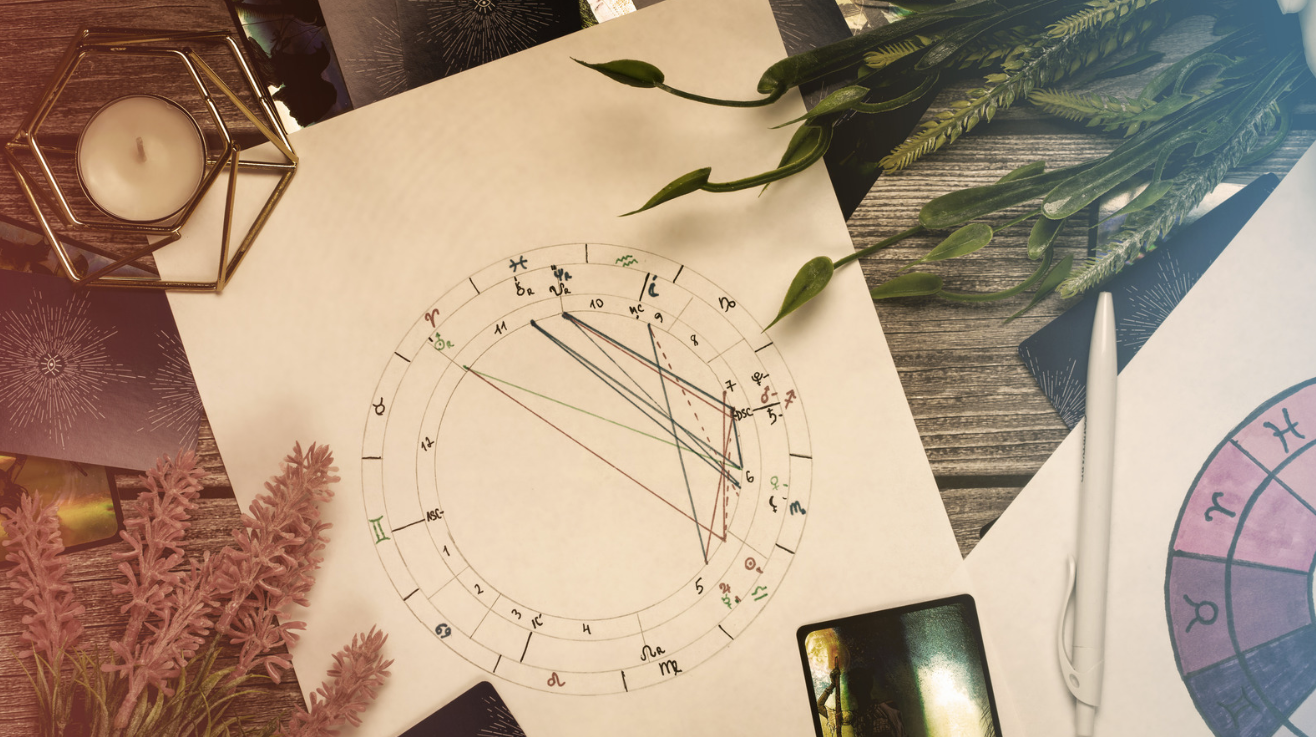
Synastry is an astrological method that compares two birth charts. Astrologers examine how one person’s planets form aspects to the other person’s planets and where those planets fall in each chart’s houses. The result is a symbolic relationship map, not a scientific test or guarantee of compatibility. Accurate birth data improves chart consistency, while consent, behavior and shared values remain essential.
What does a synastry chart show?
A synastry chart may highlight themes involving attraction, emotional needs, communication, conflict, commitment and growth. It compares chart factors rather than predicting one fixed outcome. Supportive aspects do not make a relationship safe, and challenging aspects do not doom it. Use the interpretation as a conversation prompt and compare it with present behavior.
The six-layer synastry framework
Data
Confirm birth dates, places and the accuracy of both birth times.
Planets
Identify which functions and needs are being compared.
Aspects
Review angular relationships and the orbs being used.
Houses
Explore which life areas each person may activate.
Patterns
Look for repeated themes rather than one dramatic contact.
Reality
Check consent, values, behavior, safety and practical fit.
Birth data and chart accuracy
Synastry normally uses each person’s birth date, place and time. The birth time affects the rising sign, house cusps and sometimes the Moon’s exact position. When a time is unknown or approximate, an astrologer should explain which parts of the reading remain uncertain.
- Use a documented birth time where possible.
- Mark an approximate time clearly.
- Do not invent precision when the time is unknown.
- Ask permission before using another person’s birth data.
- Protect dates, places and times as personal information.
For ascendant foundations, read Rising Sign Meaning: Birth Time, Traits and Limits.
Planets commonly emphasized in synastry
Sun
Identity, vitality, purpose and broad self-expression themes.
Moon
Emotional habits, comfort, attachment and security themes.
Mercury
Communication, interpretation and problem-solving themes.
Venus
Affection, pleasure, attraction and relationship values.
Mars
Desire, initiative, assertion and conflict style.
Saturn
Commitment, responsibility, structure, delay and pressure themes.
Outer planets may be interpreted through transformation, idealization or generational themes. No planet establishes character, consent or diagnosis.
What is an aspect?
An aspect is the angular relationship between two chart points. Astrologers differ in which aspects and allowable orbs they use.
| Aspect | Approximate angle | Common symbolic theme | Grounded question |
|---|---|---|---|
| Conjunction | 0° | Concentration or blending | How do these needs combine in daily life? |
| Sextile | 60° | Opportunity and cooperation | Do both people actively use the opportunity? |
| Square | 90° | Friction, action or tension | Can disagreement be handled safely and constructively? |
| Trine | 120° | Ease or natural flow | Does ease produce reciprocity or complacency? |
| Opposition | 180° | Polarity, projection or balance | Can differences be negotiated without control? |
| Quincunx | 150° | Adjustment or mismatch | Which expectations need explicit adaptation? |
What is an orb?
An orb is the distance from an aspect’s exact angle that an astrologer still treats as active. A tighter orb is usually considered more exact within astrological practice. Different schools use different limits, so a report should state the settings rather than presenting one universal rule.
Exactness within an astrological system does not turn the interpretation into scientific proof. It only describes how closely the chart matches the selected astrological geometry.
Personal planets and relationship experience
Contacts involving the Sun, Moon, Mercury, Venus and Mars are often emphasized because astrologers associate them with everyday identity, emotion, communication, affection and desire. A single Venus–Mars contact may be interpreted as chemistry, but it cannot prove lasting compatibility or sexual consent.
Saturn contacts
Saturn is frequently linked with commitment, responsibility and endurance, but also restriction or fear. A strong Saturn contact does not guarantee marriage or justify staying in a burdensome relationship. Ask whether responsibility is mutual and freely chosen.
Neptune contacts
Neptune contacts may be interpreted as inspiration, compassion, idealization or confusion. Use extra care with unverifiable assumptions, secrecy and rescue fantasies. Identity and financial checks remain important even when a connection feels spiritual.
Pluto contacts
Pluto contacts may be described as intense, transformative or power-related. Intensity is not permission for coercion, surveillance or control. A “Plutonic bond” does not excuse abuse.
Uranus contacts
Uranus contacts may be associated with excitement, independence and unpredictability. A relationship still needs explicit agreements about commitment, contact and autonomy.
House overlays
A house overlay occurs when one person’s planet falls into a house in the other person’s chart. The interpretation depends heavily on birth-time accuracy.
| House area | Common synastry theme | Practical question |
|---|---|---|
| 1st house | Identity, visibility and immediate impression | Can both people be authentic rather than perform a role? |
| 4th house | Home, roots and emotional privacy | Are home and family expectations compatible? |
| 5th house | Romance, play and creativity | Do attraction and enjoyment coexist with reliability? |
| 7th house | Partnership and projection | Do both people want the same relationship structure? |
| 8th house | Intimacy, vulnerability and shared resources | Are sex, debt, money and privacy handled transparently? |
| 10th house | Career, reputation and public roles | Does the relationship support each person’s work and autonomy? |
Aspect patterns and repeated themes
A responsible reading should not reduce the relationship to one contact. Look for repeated themes across planets, aspects and houses. If communication appears difficult in several places, translate that theme into specific questions about listening, timing and conflict repair.
Synastry versus composite charts
Synastry compares two separate charts. A composite chart combines the charts mathematically to create a symbolic chart for the relationship itself. The methods answer different astrological questions and should not be treated as competing verdicts.
For karmic and composite interpretations, read Karmic Relationship Charts: Beliefs, Patterns and Limits.
Synastry versus practical compatibility
| Astrological theme | Real-world evidence |
|---|---|
| Emotional harmony | Can needs be named, heard and respected? |
| Strong attraction | Is desire mutual, safe and consensual? |
| Commitment potential | Do both people choose the same level of commitment? |
| Communication challenge | Can misunderstandings be repaired without contempt? |
| Shared purpose | Do values and practical plans actually align? |
| Transformative bond | Does the relationship support health and functioning? |
Can synastry identify a soulmate?
Astrologers may describe certain contacts as significant, but no chart proves that one person is your only soulmate. A strong chart match does not override a breakup or make an unavailable person yours.
See Soulmate Search: Beliefs, Compatibility and Choice.
Can synastry predict marriage?
A synastry reading may discuss commitment themes, but marriage requires mutual choice and carries legal and financial consequences. No aspect guarantees it.
Can synastry prove cheating?
No. A chart cannot verify infidelity. Clarify exclusivity, use observable evidence and protect sexual health. Do not accuse someone from a chart interpretation alone.
Consent and chart compatibility
- A favorable chart does not create romantic or sexual consent.
- A difficult chart does not justify discrimination or mistreatment.
- A breakup must be accepted regardless of aspects.
- Do not obtain or publish another person’s birth data deceptively.
- Legal boundaries and protective orders always apply.
Relationship-safety limits
Astrology does not explain away harm
Threats, stalking, sexual coercion, financial control and violence require practical safety support. Do not remain because an astrologer calls the relationship karmic, fated or transformative. Contact emergency services for immediate danger.
How to choose a synastry reader
- Ask which astrology tradition and house system they use.
- Confirm whether accurate birth times are required.
- Request the orb settings and chart method.
- Check the cost, duration and whether a written report is included.
- Choose a reader who acknowledges uncertainty.
- Avoid guaranteed marriage, soulmate or reunion claims.
- Protect birth data and payment information.
A grounded synastry consultation
- Obtain consent to use both sets of birth data.
- Mark uncertain birth times.
- Choose three relationship topics.
- Review repeated chart themes rather than one aspect.
- Translate each theme into a direct conversation question.
- Compare the interpretation with behavior and agreements.
- Make reversible decisions from present evidence.
The chart is a conversation map
Its best use is helping two people discuss needs and patterns. It should not become a verdict that replaces consent, compatibility or choice.
Related astrology and relationship guides
- Love Horoscope: Astrology, Compatibility and Limits
- Karmic Relationship Charts: Beliefs, Patterns and Limits
- Life Path and Zodiac Compatibility: Meanings and Limits
- Rising Sign Meaning: Birth Time, Traits and Limits
- Spiritual Connection: Signs, Meaning and Boundaries
Frequently asked questions
1. What is synastry?
Synastry is an astrological comparison of two birth charts using planets, aspects and house overlays.
2. What birth information is needed?
Birth date and place are needed, and an accurate birth time is important for rising signs and houses.
3. Can synastry work without a birth time?
Some planetary aspects can still be compared, but houses and angles may be unreliable.
4. What is an aspect?
It is the angular relationship between two chart points within an astrologer’s selected orb.
5. What is an orb?
It is the allowed distance from an exact aspect angle.
6. Which planets matter most?
Astrologers often emphasize the Sun, Moon, Mercury, Venus, Mars and Saturn.
7. What are house overlays?
They describe where one person’s planets fall within the other person’s chart houses.
8. Is a square always bad?
No. It is commonly interpreted as tension or action, and the real outcome depends on behavior and context.
9. Is a trine always good?
No. It may symbolize ease, but ease does not guarantee responsibility or compatibility.
10. Can synastry identify a soulmate?
No chart objectively proves a soulmate identity.
11. Can synastry predict marriage?
It may suggest commitment themes but cannot guarantee marriage.
12. Can synastry prove cheating?
No. A chart cannot verify infidelity or another person’s private behavior.
13. Is synastry the same as a composite chart?
No. Synastry compares two charts; a composite creates a symbolic chart for the relationship.
14. Does good synastry imply consent?
No. Consent must be explicit, voluntary and ongoing.
15. What is the best way to use synastry?
Use repeated themes as prompts for direct discussion, then evaluate the relationship through present behavior.