

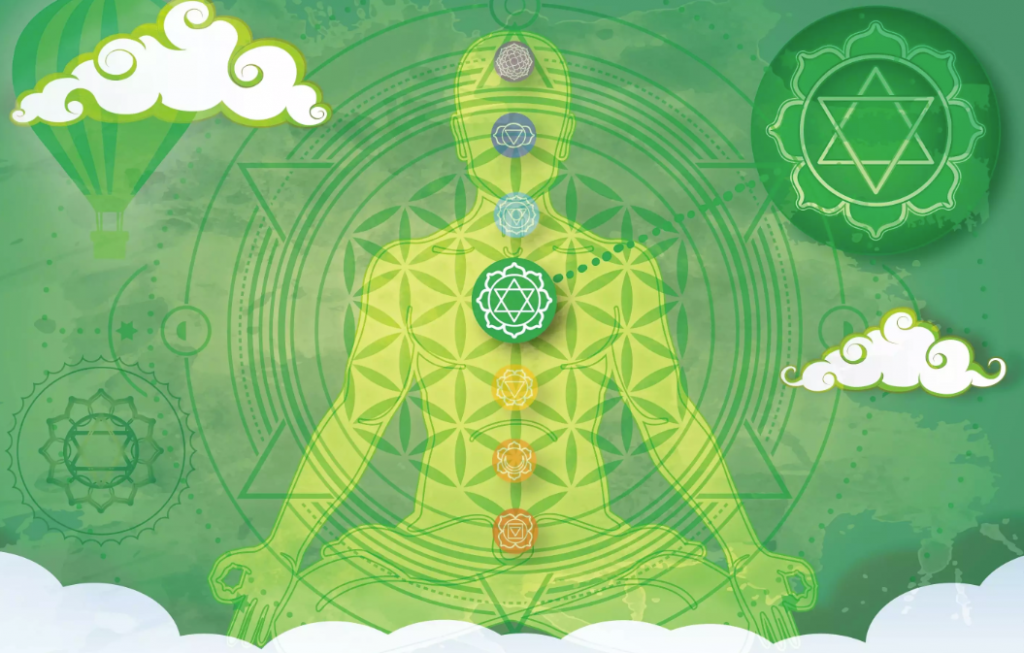
The heart chakra is a spiritual symbol commonly associated with love, compassion, grief, connection, reciprocity and boundaries. In many modern seven-chakra systems it is called Anahata and placed near the center of the chest. Chakra teachings vary across South Asian religious and philosophical traditions, and the popular seven-chakra map is one influential framework rather than a scientifically established anatomy.
What does the heart chakra mean?
The heart chakra symbolizes how a person gives and receives care while maintaining dignity, consent and self-respect. A grounded practice may include reflection, meditation, prayer, movement, gratitude, color, sound or symbolic objects. It should also include direct communication, reciprocal relationships, grief support and practical boundaries. Chakra language cannot diagnose heart disease, trauma, depression or another medical condition.
The six-part heart chakra practice
Notice
Name the emotion, relationship and body sensations without diagnosing energy.
Care
Meet sleep, food, medical, grief and support needs before ritual.
Boundary
Protect body, time, money, privacy and the right to say no.
Connect
Choose reciprocal people and communicate needs directly.
Reflect
Use an optional spiritual practice without forcing a result.
Act
Take one compassionate step that respects everyone’s choice.
Chakra teachings are varied
The Sanskrit name Anahata is often translated as “unstruck.” Historical chakra systems describe different numbers, locations, sounds, deities and purposes. Modern yoga and New Age teachings often connect Anahata with the color green, air, love and the center of a seven-chakra sequence. Those associations may be meaningful without representing every Hindu, Buddhist, yogic or tantric tradition.
Use culturally specific teachings with care. Avoid presenting one simplified diagram or commercial product as the universal ancient system.
What the heart chakra commonly symbolizes
Compassion
Recognizing suffering and responding without erasing accountability or personal limits.
Receiving care
Allowing appropriate support, affection and help without believing every gift creates a debt.
Reciprocity
Relationships in which interest, responsibility, repair and effort are not carried by one person alone.
Grief
Making space for love and loss without demanding a fixed schedule for healing.
Boundaries
Protecting consent, privacy, time, money and emotional capacity.
Connection
Belonging with partners, friends, family, community, faith, nature or self.
What does a “blocked” heart chakra mean?
In spiritual language, a blocked or imbalanced heart chakra may describe grief, resentment, isolation, jealousy, difficulty trusting, overgiving or fear of closeness. These experiences can also reflect trauma, depression, anxiety, abuse, attachment patterns, burnout, bereavement, discrimination, illness or incompatible relationships.
| Experience | Spiritual reflection prompt | Practical checks |
|---|---|---|
| Difficulty trusting | What would make trust safer and more gradual? | Past betrayal, current behavior, trauma and boundaries |
| Overgiving | What do I fear will happen if I stop rescuing? | Burnout, codependency, financial pressure and unequal responsibility |
| Jealousy | Which need or fear is asking for attention? | Relationship agreements, evidence, self-worth and communication |
| Grief | How can love remain while life changes? | Loss support, sleep, appetite, functioning and professional care |
| Emotional numbness | Which small experience feels tolerable? | Trauma, depression, medication, exhaustion and medical needs |
| Fear of closeness | What pace and boundary preserve choice? | Safety, compatibility, attachment and trauma-informed support |
Do not use a chakra label to diagnose another person or explain every relationship problem.
Begin with physical and emotional safety
A heart-focused practice should not begin by forcing vulnerability. Ask:
- Am I physically safe with this person?
- Can I say no without punishment?
- Are there threats, stalking, coercion or financial control?
- Do I have food, shelter, medication and rest?
- Is grief or low mood affecting daily functioning?
- Which professional or community resource may help?
Love does not require staying in danger
A relationship can feel spiritually significant and still be abusive or unsafe. Meditation, forgiveness, crystals or visualization cannot make another person stop harming you. Use individualized safety planning and emergency services for immediate danger.
Review Toxic Behavior: Warning Signs, Boundaries and Safety.
Self-compassion without avoiding responsibility
Self-compassion means responding to pain with honesty and care. It does not require claiming that every action was acceptable.
| Self-compassion | Avoidance |
|---|---|
| “I made a harmful choice and can repair what is possible.” | “My intention was good, so the impact does not matter.” |
| “I am struggling and deserve appropriate support.” | “My pain excuses hurting other people.” |
| “I can learn without hating myself.” | “I should never face consequences.” |
| “I can set a boundary and still care.” | “Love means everyone must accept my behavior.” |
“I can treat myself with dignity while taking responsibility for what belongs to me.”
Giving and receiving
Healthy care includes choice on both sides. Giving can become controlling when it creates an unspoken debt, ignores a no or makes another person responsible for the giver’s self-worth. Receiving does not require accepting unwanted touch, gifts, advice, sex or access.
- Ask before helping.
- State whether a gift has conditions.
- Accept a declined offer.
- Do not keep score secretly.
- Request rather than hint.
- Notice whether care is reciprocal over time.
- Protect financial and emotional capacity.
Boundaries are part of love
Time
“I can talk for twenty minutes, then I need to rest.”
Touch
“Please ask before hugging me.”
Money
“I am not able to lend or pay for this.”
Privacy
“I do not share passwords, medical records or intimate images.”
Contact
“I am not available for further messages. Please respect this boundary.”
Belief
“You may hold that spiritual belief, but do not assign it to me.”
Boundaries describe what you will participate in or do next; they are not threats designed to control someone else.
Forgiveness is optional and personal
Some heart-chakra teachings emphasize forgiveness. Forgiveness may mean releasing a personal burden, changing how you carry a memory or choosing not to pursue revenge. It does not have to mean reconciliation, restored trust, dropped legal action, silence or renewed contact.
Do not pressure a survivor to forgive
Spiritual teachers, relatives and partners should not use forgiveness to bypass accountability or safety. Distance and anger may carry important protective information.
Gratitude without denial
A gratitude practice can broaden attention, but it should not erase grief, injustice or unmet needs.
- Name one specific supportive experience.
- Name one difficult reality that also deserves attention.
- Identify who or what contributed to the support.
- Choose whether appreciation needs expression.
- Take one practical step related to the difficult reality.
“I am grateful for my friend’s call, and I still need professional grief support” can hold both truths.
A two-minute heart-centered orientation
- Choose a supported position.
- Keep eyes open if preferred.
- Notice the chair, floor or bed beneath you.
- Place a hand on the chest only if that feels comfortable.
- Let breathing remain natural.
- Name one emotion without trying to change it.
- Ask what compassionate action is possible now.
No warmth, opening or energy movement is required. Stop when body focus feels distressing.
Meditation and visualization
Some people visualize green light, expanding space or a protected center. Treat the image as an optional focus rather than literal proof that the chakra is open or closed.
- Set a short timer.
- Keep eyes open or softly focused when needed.
- Use a neutral external object if body focus increases distress.
- Do not force emotional release.
- End by orienting to the room and naming a practical step.
Use How to Meditate: Posture, Breathing and Daily Practice.
Breathing without forcing
Natural breathing is enough. Very deep, rapid or prolonged breathing may cause dizziness, tingling, panic or feelings of unreality. Those sensations do not prove chakra activation.
Stop altered breathing for concerning symptoms
Seek medical help for chest pain, fainting, severe shortness of breath or symptoms that do not settle. Use individualized clinical guidance for respiratory, cardiac, neurological or pregnancy-related concerns.
Affirmations that preserve reality
- I can care without abandoning myself.
- Love and consent belong together.
- I can receive help without owing access.
- I can grieve without rushing.
- Forgiveness does not require reconciliation.
- I can check behavior before extending trust.
- My boundary does not make me unloving.
- I can choose one compassionate next step.
Avoid affirmations that deny real danger. “I am completely safe” may be false; “I am identifying the safest available action” may be more useful.
Movement and yoga
Walking, stretching, dance, tai chi or yoga may support body awareness and emotional expression when suitable. No pose is required to open the heart chakra, and pain is not proof of release.
- Choose movement appropriate to health and mobility.
- Use stable support and accessible variations.
- Do not force backbends or shoulder positions.
- Stop for pain, dizziness, numbness or shortness of breath.
- Ask a qualified instructor or clinician about relevant limitations.
The National Center for Complementary and Integrative Health summarizes yoga safety considerations.
Dance, pleasure and consent
Dance can be expressive and joyful, but it is not required and does not need to be sexual. Partner dancing requires consent, appropriate touch and the freedom to stop. Pole, belly dance, salsa, tango and other forms are movement choices rather than spiritual duties.
Flirting is not a chakra requirement
Flirting may be enjoyable when interest is mutual and context is appropriate. Do not use heart-chakra language to encourage unwanted attention toward a coworker, service worker, student, client or stranger.
- Notice whether the other person participates voluntarily.
- Ask once and accept no or uncertainty.
- Do not confuse friendliness with attraction.
- Respect workplace and professional boundaries.
- Stop after rejection or nonresponse.
Heart chakra and relationships
A spiritual connection does not prove compatibility. Evaluate communication, reciprocity, exclusivity, sex, money, family, location, values and conflict repair.
| Spiritual statement | Relationship reality check |
|---|---|
| My heart opens around this person. | Do I feel safe, respected and free to disagree? |
| We have a soul bond. | Do both people freely choose the relationship? |
| They trigger my healing. | Are they accountable, or am I explaining repeated harm? |
| I sense their hidden love. | What have they directly said and consistently done? |
| Our separation is part of the journey. | Has a breakup or no-contact boundary been set? |
Read Spiritual Connection: Signs, Meaning and Boundaries.
Heartbreak and breakup recovery
Heartbreak may affect sleep, appetite, concentration and identity. It does not mean the chakra is permanently damaged.
- Follow contact boundaries.
- Reduce social-media checking.
- Separate financial and digital access.
- Restore food, sleep and routines.
- Use friends, therapy or support groups.
- Do not pay for guaranteed reunion rituals.
Use Breakup Recovery: A 30-Day Plan.
Grief and continuing bonds
Dreams, memories, rituals and sensed presence may help a person maintain a bond after death. Interpretations vary. Grief does not need to be cleared from a chakra to be valid.
- Allow waves of feeling.
- Use practical support with meals, transport and paperwork.
- Create a remembrance practice that fits your beliefs.
- Avoid readers who charge repeatedly to keep contact open.
- Seek qualified grief or mental-health support when needed.
Family love and limits
Family relationships may carry cultural, religious and ancestral meaning. Being related does not create unlimited access to your body, home, money, children or private information.
Love for community and service
Compassion may include volunteering, mutual aid, advocacy or ordinary neighborly care. Sustainable service respects capacity and the leadership of affected communities.
- Ask what support is needed.
- Do not make someone’s crisis about your spiritual growth.
- Protect confidential information.
- Use reliable organizations.
- Set time and financial limits.
- Rest before resentment or burnout becomes severe.
The color green and other symbols
Green is commonly associated with the heart chakra in modern seven-chakra systems, while some practices also use pink. Clothing, cloth, art, plants or visualization may serve as attention cues. Color cannot diagnose a chakra or reveal moral character.
Crystals and symbolic objects
Rose quartz, green aventurine, jade, rhodonite, malachite and other stones are often marketed for love or heart healing. They may function as reminders or ritual objects, but they do not guarantee love, cure grief or treat cardiovascular disease.
Crystal safety
- Do not swallow stones or crystal-infused water.
- Keep small objects away from children and pets.
- Do not place heavy or sharp stones on the chest during sleep.
- Check jewelry for metal allergies.
- Do not pay inflated prices because someone predicts emotional harm.
- Use material and sourcing information where it matters to you.
Essential oils, incense and candles
Rose, lavender, jasmine, bergamot and other scents are sometimes linked with heart-centered rituals. Scents can trigger asthma, migraine, allergies or pet toxicity.
- Ventilate the room.
- Do not ingest essential oils.
- Dilute skin products appropriately and patch test when suitable.
- Keep oils away from eyes, children and pets.
- Never leave flames unattended.
- Use unscented alternatives when needed.
Food and heart chakra symbolism
Some guides associate leafy greens, green produce or foods made with care with the heart chakra. Color does not make a food spiritually superior. Choose food according to nutrition, culture, allergies, access and medical advice.
- Do not restrict food groups to balance a chakra.
- Do not use fasting as emotional punishment.
- Use qualified care for eating disorders or significant nutrition concerns.
- Avoid supplements or herbs that interact with medication.
Heart chakra and physical symptoms
Chest symptoms are not chakra evidence
Chest pain, pressure, fainting, severe shortness of breath, sudden weakness or other emergency symptoms require prompt medical attention. Do not delay care while meditating, cleansing or waiting for energy to shift.
A chakra framework is not the cardiovascular system and cannot diagnose heart, lung, breast, immune or endocrine conditions.
Mental-health boundaries
Persistent low mood, panic, trauma symptoms, compulsive relationship checking, severe sleep change or difficulty functioning deserve qualified support. Do not stop medication or therapy because a spiritual practice feels powerful.
Use urgent support for immediate risk
Contact local emergency or crisis services when you may harm yourself or someone else, cannot stay safe or are severely confused. In the United States and its territories, call or text 988; in Canada, call or text 9-8-8.
Trauma-sensitive heart practice
Chest focus, closed eyes, touch and vulnerability exercises can increase distress for some trauma survivors.
- Keep eyes open.
- Use an external object rather than chest sensations.
- Do not place a hand on the body unless wanted.
- Sit near an exit.
- Practice briefly.
- Stop before overwhelm.
- Avoid forced disclosure or forgiveness.
- Use trauma-informed professional support when needed.
When spiritual practice becomes avoidance
| Grounded practice | Avoidance pattern |
|---|---|
| Meditating before a difficult conversation | Meditating for hours instead of having the conversation |
| Using rose quartz as a boundary reminder | Buying more stones whenever fear returns |
| Reflecting on forgiveness | Returning to danger to prove spiritual growth |
| Visualizing compassion | Ignoring medical or mental-health symptoms |
| Practicing gratitude | Denying grief, anger or injustice |
Reader and healer red flags
- They diagnose a blocked heart chakra as the cause of every problem.
- They guarantee love, marriage, pregnancy, healing or reunion.
- They predict abandonment unless you buy cleansing.
- Each session reveals another expensive blockage.
- They tell you to stop healthcare or medication.
- They pressure touch, sex, secrecy or forgiveness.
- They request passwords, gift cards, cryptocurrency or large transfers.
- They claim boundaries prevent spiritual awakening.
A seven-day heart chakra practice
- Day 1: check safety, grief, health and basic care needs.
- Day 2: use the two-minute heart-centered orientation.
- Day 3: state one time, touch, money or privacy boundary.
- Day 4: ask for or receive one appropriate form of help.
- Day 5: offer care after asking what is wanted.
- Day 6: try one brief symbolic practice.
- Day 7: review reciprocity, functioning and what actually helped.
Measure love through practice
A useful heart-chakra practice should strengthen compassion, consent, boundaries and daily functioning rather than create fear that you are spiritually closed.
Related chakra and relationship guides
Frequently asked questions
1. What is the heart chakra?
It is a spiritual symbol commonly associated with love, compassion, grief, reciprocity, connection and boundaries.
2. What is Anahata?
Anahata is the Sanskrit name commonly used for the heart chakra and is often translated as “unstruck.”
3. Is the heart chakra a physical organ?
No. It is part of a spiritual framework and should not be confused with the heart, lungs or other anatomy.
4. What does a blocked heart chakra mean?
It may be spiritual language for grief, mistrust, overgiving or isolation, but practical, relational and clinical causes should also be considered.
5. How do I balance the heart chakra?
Begin with safety, care, boundaries, reciprocal connection and grief support, then add optional meditation or symbolism.
6. Is forgiveness required?
No. Forgiveness is personal and does not require reconciliation, renewed trust or contact.
7. Are boundaries unloving?
No. Boundaries protect consent, capacity and sustainable relationships.
8. Which color is associated with it?
Green is common in modern seven-chakra systems, and some practices also use pink.
9. Which crystals are used?
Rose quartz, green aventurine and similar stones are popular symbolic choices, but they do not treat illness or guarantee love.
10. Can yoga open the heart chakra?
Yoga may support reflection and body awareness, but no pose is required and pain is not evidence of opening.
11. Can heart chakra imbalance cause chest pain?
Chakra language cannot diagnose chest pain. Use prompt medical assessment for concerning symptoms.
12. Can meditation help grief?
A brief flexible practice may support some people, but it should not replace grief, mental-health or medical care.
13. What if chest-focused practice feels distressing?
Keep eyes open, use an external anchor, avoid touch and shorten or stop the practice.
14. How do I avoid chakra scams?
Avoid guaranteed love or cures, disaster predictions, escalating cleansing fees and demands for secrecy or unusual payment.
15. What is the simplest heart-chakra practice?
Check safety, name one feeling, set one compassionate boundary and choose one reciprocal act of care.