

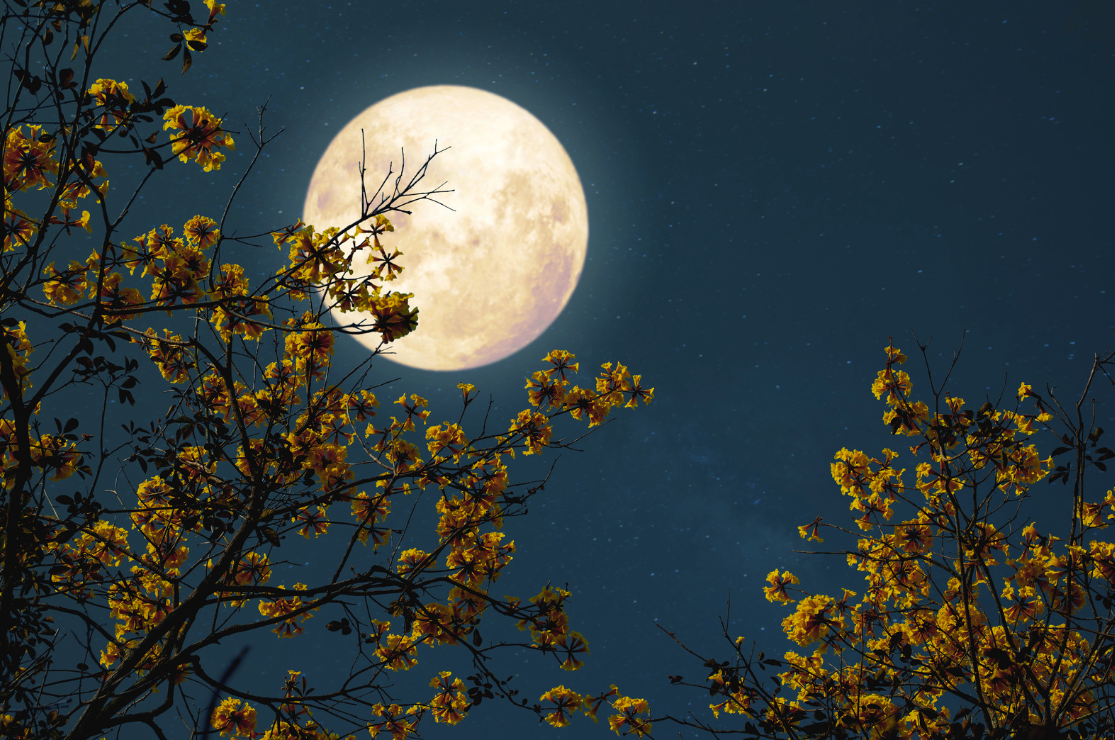
What a Full Moon Is
A full Moon occurs when the Moon is opposite the Sun in Earth’s sky, allowing us to see nearly all of its illuminated Earth-facing side. The Moon does not produce its own visible light; moonlight is reflected sunlight.
The complete phase cycle takes about 29.5 days. A full Moon rises around sunset, sets around sunrise and can look full for more than one night even though the exact phase occurs at a specific moment.
Does a Full Moon Make People Act Differently?
Folklore frequently links full Moons with insomnia, crime, psychiatric emergencies, childbirth and unusual animal behavior. Research does not support a simple claim that everyone becomes unstable or “wild” during a full Moon.
Some studies investigate subtle sleep or biological patterns, and lunar rhythms are important for certain species. That does not justify diagnosing a person, explaining a crisis or predicting behavior from the Moon phase alone.
Science
Explains the phase through the changing geometry of the Sun, Earth and Moon.
Seasonal Name
Connects a full Moon with weather, plants, animals or work associated with a time of year.
Spiritual Meaning
Uses the full Moon as a personal symbol for reflection, completion or release.
Common Full Moon Names by Month
The names below are common in modern North American calendars, but lunar naming traditions vary by culture, language, region and year. A single month may have several names, and the list should not be treated as one universal Indigenous system.
January — Wolf Moon
Often associated with winter, cold, hunger and the sound of wolves. Reflective theme: endurance and community.
February — Snow Moon
Linked with heavy winter snow in parts of the Northern Hemisphere. Reflective theme: patience and conservation.
March — Worm Moon
Associated in popular calendars with thawing soil, signs of spring and renewed animal activity. Reflective theme: emergence.
April — Pink Moon
Named for pink spring flowers rather than the Moon’s color. Reflective theme: growth and renewal.
May — Flower Moon
Associated with abundant flowering in Northern Hemisphere spring. Reflective theme: development and care.
June — Strawberry Moon
Connected in popular naming traditions with the seasonal strawberry harvest, not a Moon that turns strawberry-colored. Reflective theme: appreciation.
July — Buck Moon
Associated with new antler growth on male deer. Reflective theme: strength, responsibility and maturation.
August — Sturgeon Moon
Connected with seasonal fishing traditions around large North American lakes. Reflective theme: resources and stewardship.
September — Corn Moon
A seasonal harvest name often associated with late-summer crops. Reflective theme: gathering results.
Harvest Moon
The full Moon closest to the Northern Hemisphere’s September equinox. It can occur in September or October.
Hunter’s Moon
The full Moon following the Harvest Moon, usually in October but occasionally in November.
November — Beaver Moon
A name associated with late-autumn preparation and seasonal animal activity. Reflective theme: readiness.
December — Cold Moon
Associated with long nights and winter cold in the Northern Hemisphere. Reflective theme: review and rest.
Why Full Moon Names Are Not Universal
Seasonal observations differ between hemispheres, climates and communities. June is summer in the Northern Hemisphere and winter in the Southern Hemisphere, so a single seasonal label cannot describe every location.
When writing about a culturally specific name, identify the source and community where possible. Avoid combining names from several traditions and presenting them as one authoritative list.
Sleep, Mental Health and Behavior
A large population-based sleep study found no significant overall difference in sleep quality or objective sleep duration across lunar phases. A 2026 study of psychiatric emergency consultations likewise found no significant correlation with Moon phase.
Individual people may notice patterns in sleep, mood or routine. To evaluate a personal pattern, record sleep, light exposure, stress, caffeine, medication, work schedule and Moon phase over several months rather than relying on memory alone.
Do not attribute severe insomnia, mania, depression, hallucinations, aggression or medical symptoms to the full Moon. Seek appropriate professional help.
Full Moon Rituals With Clear Limits
A full Moon ritual can be a structured reflection rather than a prediction:
- Observe the Moon from a safe location.
- Write one completed task or lesson from the previous month.
- Name one burden or habit you want to reduce.
- Choose one realistic action for the next week.
- Close with gratitude, prayer, meditation or quiet observation.
The ritual does not guarantee fertility, money, healing, reconciliation or manifestation. It should not replace medical, financial or relationship-safety decisions.
Full Moon, Blue Moon, Supermoon and Eclipse
- Full Moon: the ordinary lunar phase occurring roughly every 29.5 days.
- Blue Moon: usually the second full Moon in one calendar month, or the third of four in a season.
- Supermoon: an informal term for a full Moon relatively near the closest part of its orbit.
- Lunar eclipse: Earth’s shadow crosses the Moon during a specific full-Moon alignment.
Read Blue Moon Superstitions: Folklore, Facts and Safety and Moon Phases: Science, Spiritual Meaning and Rituals.
Frequently Asked Questions
1. How long is the lunar phase cycle?
The cycle from one new Moon to the next takes about 29.5 days.
2. Why does the Moon look full?
From Earth, we see nearly all of the Moon’s sunlit near side when it is opposite the Sun in the sky.
3. Does a full Moon last all night?
The exact phase is one moment, but the Moon can appear full for a couple of nights.
4. Does a full Moon cause insomnia?
Research findings are mixed, and large studies do not support a simple effect on everyone’s sleep.
5. Does a full Moon cause mental illness or crime?
No evidence supports treating the Moon phase as a general cause of psychiatric crisis or criminal behavior.
6. Do animals respond to lunar cycles?
Some species have documented lunar or tidal rhythms, but responses vary and should not be generalized to every animal.
7. Are monthly full Moon names scientific terms?
No. They are seasonal and cultural names rather than formal astronomical classifications.
8. Why is April called the Pink Moon?
The name refers to spring flowers in a popular naming tradition, not a Moon that normally looks pink.
9. Why is June called the Strawberry Moon?
The name is associated with a seasonal strawberry harvest in some North American traditions.
10. Can the Harvest Moon occur in October?
Yes. It is the full Moon closest to the September equinox, so it may occur in September or October.
11. Is a full Moon safe to view?
Yes. Ordinary full Moons and lunar eclipses can be viewed without solar eclipse glasses.
12. Can a full Moon ritual manifest an exact result?
No. A ritual can support intention and reflection but cannot guarantee an outcome.
13. Does a full Moon affect pregnancy or childbirth?
A lunar phase should not be used to predict pregnancy, labor or medical outcomes.
14. What is a Blue Moon?
It usually means the second full Moon in one calendar month, though a seasonal definition also exists.
15. What is the best way to track the Moon?
Use a reliable lunar calendar and record your own observations, dates, times and local conditions.
Science and Editorial Sources
Population-Based Study of Lunar Phase and Sleep
2026 Study of Lunar Cycle and Psychiatric Emergency Consultations
Names and meanings are presented as variable traditions, not universal scientific effects. See the Expert Psychics Editorial Policy.
Corrected and last reviewed: August 18, 2026.