

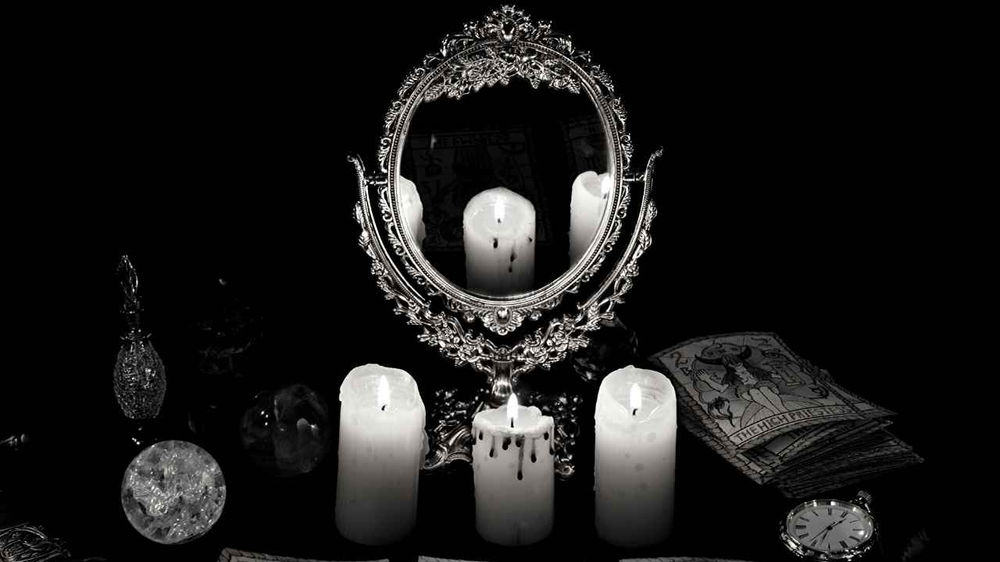
A scrying mirror is a dark or reflective surface used for focused observation and symbolic interpretation. A practitioner may notice shifting light, shapes, memories, words, emotions or imagined scenes and explore what they personally mean. Some people understand the practice spiritually; others use it as meditation or creative reflection. A mirror does not reliably reveal hidden facts or guaranteed future events.
How do you use a scrying mirror?
Place a stable mirror in soft indirect light, choose one open question, set a short timer and use a relaxed gaze without staring into bright reflections. Record the first raw impressions before assigning meaning, consider ordinary visual and psychological explanations, then choose only a low-risk, reversible next step. Stop for eye strain, fear, disorientation or loss of sleep.
The six-part scrying mirror method
Set up
Use a secure mirror, comfortable seat and ordinary safe lighting.
Question
Choose one open prompt about your own reflection or choices.
Observe
Notice light, shape, thought and emotion without forcing imagery.
Record
Write the observation before the interpretation.
Compare
Consider personal, environmental and spiritual explanations.
Ground
Return to the room, facts and one safe next step.
What is scrying?
Scrying is a broad name for divination or contemplation using a visual field. Water, polished stone, metal, glass, smoke, flame, crystal spheres and mirrors have all been used in different places and periods. Modern practices combine historical references, occult traditions, personal ritual and contemporary meditation techniques.
No single mirror color, frame, moon phase, candle number or ritual script is required for every scrying tradition.
What makes a scrying mirror different?
A scrying mirror is usually darker and less detailed than an ordinary household mirror. The reduced visual information can make reflections feel ambiguous, allowing memory, imagination and pattern recognition to become more noticeable.
| Tool | Visual quality | Practical consideration |
|---|---|---|
| Black glass mirror | Dark reflective surface with limited detail | Can break; needs a stable stand and safe edges |
| Obsidian mirror | Natural or manufactured dark polished surface | May be expensive, heavy or fragile |
| Ordinary mirror in dim light | Clear reflection with reduced contrast | Faces can appear to shift during prolonged gaze |
| Dark bowl of water | Moving reflections and depth | Spill risk near electronics, candles or slippery floors |
| Crystal ball | Curved reflections and internal visual effects | Heavy spheres can roll and clear glass can focus sunlight |
| Blank dark screen | Accessible reflective surface | Protect privacy and avoid notifications or recorded content |
For the sphere-based method, read Crystal Ball Readings: Meaning, Methods and Safety.
Choosing a mirror
- Select a size that can be supported securely.
- Check for cracks, sharp edges and unstable frames.
- Use a stand that cannot tip easily.
- Avoid antique reflective coatings containing unknown hazardous materials.
- Keep heavy mirrors away from beds, children and pets.
- Do not assume price, stone type or ritual origin guarantees stronger results.
Can you make a scrying mirror?
A simple dark reflective surface can be purchased or made, but glass and coating safety matter. The easiest low-risk option is often a commercially finished dark mirror or a secure picture frame with a dark backing rather than cutting glass yourself.
DIY safety
- Use intact glass with finished edges.
- Follow ventilation instructions for paint or coating products.
- Keep coatings away from food, flames, children and pets.
- Wear appropriate protection when a product requires it.
- Do not heat, grind or break unknown glass.
- Dispose of chemicals and broken materials according to local rules.
Set up the room
You do not need complete darkness. Use enough light to walk safely and see the timer, door and surroundings. Place the mirror so it does not reflect a bright lamp directly into the eyes.
Helpful setup
- Stable table or stand
- Supportive chair
- Soft indirect light
- Clear floor and exit
- Notebook and timer
- Water and ventilation
Avoid
- Direct sunlight
- Open flame near fabric
- Locked or inaccessible rooms
- Intoxication
- Sleep deprivation
- Sessions during driving or caregiving duties
Candle and fire safety
Candles are optional. Battery candles or ordinary lamps can create the same ritual cue without an open flame.
Do not leave fire unattended
- Keep flames away from curtains, paper, hair, clothing and coatings.
- Use a stable nonflammable holder.
- Maintain ventilation.
- Keep children and pets away.
- Extinguish the flame before becoming drowsy or leaving.
- Do not use smoke when asthma, migraine or building rules make it unsafe.
Eye and visual safety
Use a soft gaze, blink normally and look away periodically. Do not stare into the Sun, a laser, a bright lamp or intense flame. Stop for eye pain, headache, nausea or persistent visual disturbance.
- Wear your usual corrective lenses if needed.
- Keep sessions brief.
- Do not press the eyes.
- Avoid rapid flashing light.
- Use ordinary eye care for new symptoms.
- Seek prompt care for sudden vision loss, many new flashes or floaters, injury or a curtain-like shadow.
Why reflections may seem to change
In dim or unchanging visual conditions, details can fade, shadows can become more prominent and the mind may organize ambiguous shapes into faces or scenes. Small eye movements, room reflections, expectation, fatigue and imagination can contribute.
These ordinary processes do not prevent someone from finding personal or spiritual meaning. They do mean that a shifting face or figure should not be treated as verified evidence of a spirit or real person.
Choose a grounded question
| High-certainty question | Grounded alternative |
|---|---|
| Who is secretly against me? | Which conflict, boundary or fear needs direct examination? |
| Will my ex return? | What helps me respond to the relationship that exists now? |
| Am I sick? | Which symptoms and questions should I take to a clinician? |
| Which investment will win? | What risks, fees and regulated information are missing? |
| Where is the missing person? | Which official response or verified information needs action? |
| What is my fixed destiny? | Which value can guide one manageable decision? |
A ten-minute beginner session
- Check that the room and mirror are physically safe.
- Write one open question.
- Set a timer for ten minutes or less.
- Orient to the date, place and points of support.
- Let breathing remain natural.
- Rest the gaze near the center or surface.
- Notice the first color, shape, thought, memory or feeling.
- Look away and blink periodically.
- Write the raw impression.
- End by naming the next ordinary activity.
Seeing nothing is a valid result
Do not extend the session, strain the eyes or purchase more tools because no image appeared.
Separate observation from interpretation
| Layer | Example | Purpose |
|---|---|---|
| Observation | A pale shape appeared near the left edge. | Records what seemed visible. |
| Association | It reminded me of fog around a doorway. | Identifies memory and symbolism. |
| Emotion | I felt curious and slightly uneasy. | Tracks the internal response. |
| Interpretation | I may feel uncertain about a new opportunity. | Creates one possible meaning. |
| Alternative | A curtain reflection and visual adaptation may explain it. | Preserves uncertainty. |
| Action | Gather more information before accepting the opportunity. | Returns to practical choice. |
Common symbols
No symbol has one universal meaning. Personal experience, culture, question and emotion matter.
| Image | Possible prompts | Reality check |
|---|---|---|
| Door or opening | Opportunity, boundary, transition or access | Who has authority, and what permission is required? |
| Water or mist | Emotion, uncertainty, cleansing or change | Could light, moisture or recent memory explain it? |
| Face | Relationship, identity, memory or pattern recognition | Do not identify or accuse a real person from the image. |
| Animal | Instinct, personal memory or cultural symbolism | What does that animal mean to you specifically? |
| Road | Direction, movement, choice or delay | What real options and constraints exist? |
| Color | Mood, attention or spiritual association | Check room lighting and individual color meaning. |
Keep a scrying journal
- Date and time
- Question
- Lighting and room setup
- Sleep, stress, medication and substances
- Exact observation
- Personal associations
- Several possible meanings
- Any prediction with a deadline
- Action taken
- Outcome, including misses
A timestamped journal reduces hindsight changes. Do not rewrite a vague image after an event to make it appear exact.
Scrying and meditation
Mirror gazing can function as a visual meditation, but it may be less suitable for people who become distressed by changing faces, dissociation or intrusive imagery. A neutral object, sound or eyes-open grounding practice may be better.
Read How to Meditate: Posture, Breathing and Daily Practice.
Scrying and the third eye
Some practitioners understand mirror imagery through third eye or clairvoyant beliefs. Treat that as a spiritual interpretation rather than proof that the mirror opened an anatomical structure or verified an external event.
See Third Eye Meaning: Ajna Chakra, Beliefs and Limits.
Scrying and automatic writing
You may write freely after observing the mirror. Preserve the raw notes and distinguish spontaneous language from checkable claims. Do not follow commands involving harm, money, medication, secrecy or another person’s rights.
Read Automatic Writing Guide: Meaning, Methods and Safety.
Using a mirror for grief
A bereaved person may hope to see a deceased loved one. Memory, longing and ambiguous reflection can create a powerful experience. It may feel comforting without confirming communication or requiring repeated sessions.
- Do not promise contact.
- Do not interpret silence as rejection.
- Stop when the practice increases fear or sleep loss.
- Use grief support when functioning is impaired.
- Avoid readers who charge repeatedly to protect a loved one’s spirit.
Love and relationship limits
A mirror image cannot prove that someone loves you, is cheating, will return or is a soulmate. Follow the person’s direct words, behavior and consent.
- Do not contact an ex after a no-contact request.
- Do not accuse a partner from a vision.
- Do not monitor devices or location.
- Use direct agreements for exclusivity.
- Use qualified sexual-health care when needed.
Career and money limits
Scrying cannot guarantee hiring, promotion, business success, investment profit, inheritance or lottery results.
- Verify employers and offers.
- Review written contracts.
- Check fees and total risk.
- Do not gamble from symbols or numbers.
- Use regulated information and qualified advice.
- Do not send gift cards or cryptocurrency under pressure.
Medical limits
A mirror is not a diagnostic tool
Do not interpret colors, faces, shadows or symbols as evidence of disease, pregnancy, infection or mental-health diagnosis. Do not stop medication or delay screening, urgent care or emergency services.
Legal and crime limits
A mirror image cannot establish guilt, identify a criminal, interpret a contract or predict a court decision. Do not accuse, trespass, publish a name or interfere with an investigation.
Missing people and pets
Use official response first
Contact emergency services, law enforcement, shelters, hospitals, animal control or other appropriate organizations promptly. Do not delay a report for scrying. Label any impression as unverified if an official channel agrees to receive it, and never search a dangerous area alone.
Choosing a professional reader
- Check whether scrying is a stated specialty.
- Compare rates and billing increments.
- Ask how observations are separated from interpretation.
- Review privacy and recording policies.
- Choose a reader who acknowledges uncertainty.
- Avoid guaranteed outcomes.
- Set a time and spending limit before starting.
Scrying scam warning signs
End the session when a reader
- Claims the mirror proves a curse, possession or imminent death
- Demands repeated payment to close a portal
- Guarantees reunion, pregnancy, healing or wealth
- Asks for gift cards, cryptocurrency, passwords or secrecy
- Uses an image to identify a supposed enemy
- Tells you to avoid doctors, lawyers, police or trusted people
- Threatens harm when you refuse another ritual
When imagery becomes distressing
Stop if faces, figures or messages remain intrusive after the session, increase fear, interrupt sleep or become difficult to distinguish from shared events. Open the eyes fully, turn on ordinary light, cover the mirror and reconnect with another person or activity.
Seek prompt help when
- Voices or images command dangerous action.
- You feel watched, controlled or unable to stop.
- Sleep drops sharply.
- You become severely confused.
- Work, eating or self-care decline.
- You may harm yourself or another person.
Use local emergency or crisis services for immediate danger. Spiritual interpretation should not replace qualified assessment.
How often should you practice?
No schedule is required. Brief, occasional sessions make it easier to review effects. Avoid repeating the same question until a preferred image appears.
| Useful limit | Reason |
|---|---|
| One question per session | Reduces interpretive drift |
| Five to ten minutes of gazing | Reduces eyestrain and forced imagery |
| One written interpretation | Limits compulsive re-reading |
| A full day before repeating | Allows real information to emerge |
| A fixed monthly budget | Protects against dependency and upselling |
Cleaning and storing the mirror
- Follow the material’s care instructions.
- Use a soft cloth and appropriate cleaner.
- Keep liquids away from electrical equipment.
- Store the mirror securely to prevent falls.
- Protect the surface from scratches.
- Covering it is optional and may simply reduce dust or unwanted reflections.
A seven-day scrying experiment
- Day 1: prepare the mirror and room without interpreting.
- Day 2: observe reflections and identify ordinary sources.
- Day 3: ask one low-risk personal question.
- Day 4: separate observation, association and interpretation.
- Day 5: add three alternative meanings.
- Day 6: take one reversible action or no action.
- Day 7: review eye comfort, sleep, emotion and practical usefulness.
The mirror should not control the decision
A grounded practice can generate associations and questions while leaving facts, consent and choice in ordinary life.
Related divination and intuition guides
Frequently asked questions
1. What is a scrying mirror?
It is a dark or reflective surface used for focused observation and symbolic interpretation.
2. Does a scrying mirror show literal future events?
No reliable method has established mirror gazing as a guaranteed way to see the future.
3. Must the mirror be black?
No. Dark glass, obsidian, an ordinary mirror, water or another safe reflective surface may be used.
4. Do I need candles?
No. Soft indirect light or a battery candle is safer and sufficient.
5. How long should I gaze?
Begin with a few minutes and keep the session under ten minutes until you know how it affects you.
6. What if I see nothing?
That is a normal result. Do not force an image or extend the session.
7. Why does my face seem to change?
Dim light, visual adaptation, shadows, small eye movements and expectation can alter the appearance of a reflection.
8. Can I make my own mirror?
Yes, but use intact finished glass, safe coatings, ventilation and secure construction.
9. What questions should I ask?
Use open questions about your own values, choices, missing information and low-risk next steps.
10. Can the mirror reveal another person’s thoughts?
No. Ask the person directly and respect their privacy and consent.
11. Can it diagnose illness?
No. Symptoms, diagnosis and treatment require qualified healthcare.
12. Can it locate a missing person?
No reliable method supports that use. Contact official services immediately and do not delay a report.
13. How do I protect my eyes?
Use soft indirect light, blink, look away periodically and stop for pain, headache or visual disturbance.
14. What are reader red flags?
Guaranteed outcomes, curse claims, escalating ritual fees, secrecy and unusual payment demands are serious warnings.
15. What is the safest interpretation method?
Record the raw observation, consider several explanations and choose only a reversible action supported by real-world information.