

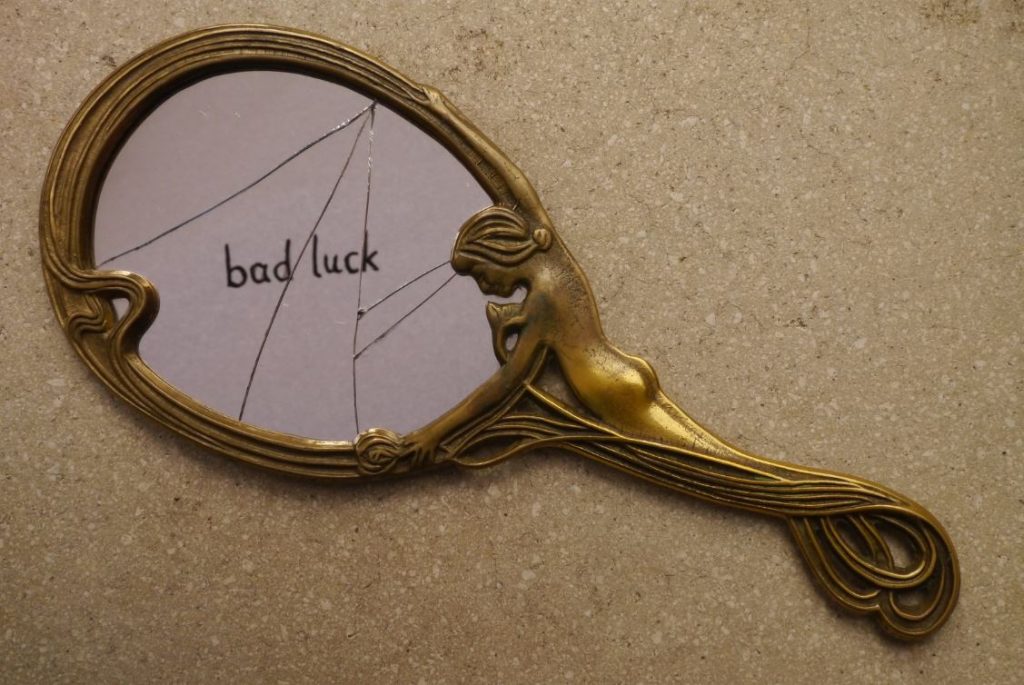
The belief that breaking a mirror brings seven years of bad luck is a familiar superstition, not an established cause-and-effect rule. Mirrors have carried practical, artistic, religious and magical symbolism across many cultures, which helps explain why damage to one can feel more significant than breaking an ordinary household object. The immediate reality is simpler: broken glass creates a cleanup and injury risk, while later misfortunes still need their ordinary explanations.
Does breaking a mirror cause seven years of bad luck?
No reliable evidence shows that a broken mirror controls the next seven years of a person’s life. The belief survives through folklore, family tradition, symbolism and the human tendency to notice events that seem to confirm a warning. Clean the glass safely, replace the mirror when practical and treat any later problem according to its actual cause rather than assuming a curse has begun.
The five-step broken-mirror response
Pause
Keep people and pets away from the area.
Clean
Use shoes, gloves and suitable tools for sharp fragments.
Check
Look for cuts, hidden shards and damage to the frame or wall.
Reset
Use a harmless ritual or grounding statement if fear remains.
Review
Explain future events through evidence, not the broken mirror.
What the superstition says
The best-known version claims that a person who breaks a mirror will experience seven years of misfortune. Variations may add that the mirror contains part of the soul, records the last reflection, reveals spiritual truth or opens a harmful doorway. Some families teach a remedy such as burying the pieces, throwing salt, turning around, praying or waiting through a lunar cycle.
These versions are folklore. They differ by place, period and storyteller, and no universal ritual is required to make a broken mirror harmless.
Why seven years?
Popular retellings often connect the number seven with ancient Rome and a supposed seven-year cycle of bodily or spiritual renewal. That story is repeated widely, but the exact origin of a bad-luck belief is difficult to document. Folklore often develops through oral transmission, and origin stories may be added after a custom is already established.
The careful historical conclusion is not “the Romans definitely invented the seven-year rule.” It is that ancient mirrors are well documented, seven has carried symbolic importance in many traditions, and the modern superstition accumulated through later folklore whose precise starting point is uncertain.
The American Folklife Center notes that traditional bad-luck beliefs often help people explain uncertainty and that the origins of long-held beliefs may be unknown. See the Library of Congress guide to traditional beliefs and superstitions.
Mirrors were important long before modern glass
People used polished stone and metal as reflective surfaces before modern household mirrors. Surviving Greek, Etruscan and Roman mirrors show that reflection, beauty, status and mythology were connected with carefully made objects. The Metropolitan Museum of Art, for example, documents a gilded Roman bronze mirror from the second century.
That evidence establishes the long history of mirrors as valued objects. It does not prove that a broken mirror caused misfortune or that one ancient culture created every later belief.
Why mirrors attract spiritual symbolism
Reflection and identity
A mirror shows a recognizable but reversed image, making it an intuitive symbol for identity, self-knowledge and appearance.
Presence and absence
A reflection appears instantly and disappears when the person leaves, which can inspire stories about souls, doubles, ghosts or memory.
Light and illusion
Mirrors redirect light and create depth, repetition and unexpected images, making them useful in ritual, art, theatre and magic.
Value and fragility
Historically, a finely made mirror could be costly. A practical warning against breaking it may acquire moral or supernatural force over time.
Mirrors as talismans and divination tools
Some historical mirrors carried protective inscriptions or imagery, and some were associated with divination. A Metropolitan Museum record describes a medieval cast-bronze mirror that served as a talisman and may have been used for divination. Read the museum’s account of a twelfth- or thirteenth-century mirror with protective motifs.
This demonstrates cultural and historical uses of mirrors. It does not make every modern mirror spiritually active or dangerous. For reflective divination as an optional symbolic practice, use the Scrying Mirror Guide: Meaning, Practice and Safety.
Why bad luck may seem to begin immediately
Breaking a mirror is itself an unpleasant event. There may be a loud crash, a financial cost, a cut, an argument or an interrupted routine. Those immediate consequences can feel like the first proof of the superstition even though they follow directly from broken glass.
Afterward, several thinking patterns may strengthen the belief:
- Confirmation bias makes matching problems stand out more than ordinary days.
- Selective memory preserves dramatic coincidences and forgets nonmatches.
- Clustering makes several unrelated problems feel like one connected streak.
- Expectation increases attention to mistakes, delays and negative news.
- Anxiety can affect sleep, concentration and decision-making, creating additional practical difficulties.
- Family stories provide a ready-made explanation before other causes are examined.
Coincidence is not proof of a curse
| Event after the break | Useful questions | Grounded response |
|---|---|---|
| A bill arrives | Was the charge created before the mirror broke? Is it correct? | Review the statement, deadline and dispute options. |
| A relationship conflict occurs | What was said, what agreement applies and what pattern existed already? | Use direct communication, boundaries and repair. |
| You become ill | What symptoms, exposures and medical factors matter? | Use appropriate healthcare instead of a curse explanation. |
| A plan is canceled | Was the cause weather, scheduling, cost, policy or another person’s choice? | Check the actual reason and available alternatives. |
| Another object breaks | Is there clutter, poor storage, fatigue or a maintenance issue? | Correct the environmental cause. |
Use Coincidence vs Synchronicity: Meaning, Bias and Context when several events feel unusually connected.
Clean broken glass safely
The real danger is physical
- Keep children and pets out of the area.
- Wear closed shoes and cut-resistant or sturdy gloves when available.
- Pick up large pieces carefully without pressing them into the hand.
- Use a broom, dustpan, disposable card or other suitable tool for smaller shards.
- Check rugs, furniture edges, vents, shoes and nearby objects.
- Use a flashlight held low to help reveal reflective fragments.
- Place shards in a rigid, puncture-resistant container or follow local disposal rules.
- Seek appropriate care for deep cuts, embedded glass, uncontrolled bleeding or possible eye injury.
Do not handle fragments for a ritual when doing so creates another injury risk. Do not bury glass outdoors, leave it at a grave, throw it into water or place it where wildlife, workers or visitors can be harmed.
Can you “reverse” the bad luck?
Because the mirror did not create a measurable curse, no supernatural reversal is required. A harmless ritual may still help mark the end of the event and reduce anxiety.
| Traditional idea | Safer symbolic alternative |
|---|---|
| Bury every fragment | Dispose of glass safely, then bury a written fear or biodegradable paper only where permitted. |
| Carry a sharp piece for protection | Keep a photograph, smooth stone or written grounding phrase instead. |
| Use smoke or flame to cleanse the room | Open a window when safe, use ordinary cleaning or light a battery candle. |
| Pay someone to remove the curse | Decline fear-based services and return to practical causes and choices. |
| Wait seven years before feeling safe | Choose a clear endpoint today: cleanup complete, injuries checked and event closed. |
A simple closing statement
“The mirror broke. I cleaned the physical hazard, and I do not need to connect unrelated events with it. I will respond to each problem using its actual evidence.”
Spiritual practice without fear
A believer may pray, meditate, ring a bell, wash their hands, replace the mirror intentionally or write about what the object symbolized. Keep the practice voluntary and low risk. It should restore choice rather than create a new list of compulsory rules.
For a broader method of responding to symbolic events, read Signs from the Universe: Meaning, Bias and Grounding.
Broken mirrors in dreams
A broken mirror in a dream may suggest self-image, identity change, embarrassment, fragmentation, aging, visibility or a recent memory of glass. It does not reliably predict seven years of misfortune. Record the dream’s events, emotion and personal associations before consulting a fixed symbol list.
Is it bad luck to keep a cracked mirror?
A cracked mirror may distort an image, shed fragments or fail unexpectedly. Replace, repair or secure it according to its physical condition. Keeping one for art or spiritual symbolism is a personal choice only when edges, mounting and stability are safe.
Should mirrors be covered after a death?
Mirror-covering appears in some mourning customs, but meanings vary by community and family. Do not reduce a living tradition to a single frightening claim that a soul will become trapped. Follow the practices of the relevant community respectfully, or ask an informed religious leader when guidance is needed.
When superstition becomes compulsive
Fear needs attention when you
- Count the days or years repeatedly.
- Avoid mirrors, rooms or ordinary activities.
- Interpret every setback as proof.
- Repeat rituals until they feel perfect.
- Seek many readers for reassurance.
- Spend beyond your budget on protection or cleansing.
- Lose sleep or struggle to work because of the belief.
Set one stopping rule: clean the hazard, complete one optional ritual and do not reopen the question without new practical information. Qualified mental-health support may help when superstition, checking or ritual behavior becomes distressing or disruptive.
Curse-removal scam warnings
- Someone says the mirror opened a portal or attached an entity.
- A reader predicts illness, death or family harm unless you pay.
- The first payment reveals a deeper blockage requiring more money.
- You are asked for gift cards, cryptocurrency, wire transfers or secrecy.
- You are told to discard valuables, stop healthcare or avoid trusted people.
- The person claims only they can make the next seven years safe.
End contact, preserve messages and use appropriate payment-provider or fraud-reporting channels when money has been taken through pressure or deception.
A seven-day fear-reset experiment
- Day 1: write the exact superstition you learned.
- Day 2: list the mirror’s real consequences and costs.
- Day 3: record ordinary events without labeling them lucky or unlucky.
- Day 4: notice one negative event and at least one neutral or positive event.
- Day 5: identify any checking, avoidance or reassurance behavior.
- Day 6: take one practical action unrelated to the superstition.
- Day 7: review whether fear decreased when events were judged separately.
The number seven can become a reflection prompt
Instead of expecting seven years of misfortune, choose seven days of safer cleanup, evidence checking and freedom from repeated reassurance.
Related guides
- Scrying Mirror Guide
- Signs from the Universe
- Coincidence vs Synchronicity
- Grounding Techniques
- Psychic Intuition
Frequently asked questions
1. Does breaking a mirror cause seven years of bad luck?
No reliable evidence shows that a broken mirror controls future events. The immediate issue is safe glass cleanup.
2. Where did the seven-year belief begin?
Popular accounts often connect it with ancient Rome, but the precise origin is uncertain and likely developed through later folklore.
3. Why are mirrors associated with souls?
Reflection, identity, presence and disappearance have made mirrors powerful symbols in many cultural and spiritual stories.
4. Were ancient mirrors made from glass?
Many ancient mirrors were made from polished metal or stone. Glass mirrors developed through later technologies.
5. Is a broken mirror a curse?
No verified process turns broken glass into a supernatural curse.
6. Do I need a ritual to reverse the luck?
No ritual is required. A harmless closing practice may reduce anxiety, but safe disposal and evidence-based thinking are enough.
7. Should I bury the pieces?
No. Buried glass can injure people and animals. Follow safe local disposal practices.
8. Can I keep one shard as a spiritual object?
A sharp shard creates an injury risk. Use a photograph, smooth object or professionally finished piece instead.
9. Is it unlucky to keep a cracked mirror?
The concern is physical stability and sharp edges, not luck. Repair, secure or replace it as needed.
10. What if bad things happen after the mirror breaks?
Review each event’s timing, evidence and ordinary causes instead of grouping unrelated problems into one curse story.
11. What does a broken mirror mean in a dream?
It may symbolize self-image, change, fragmentation or a recent memory, but it does not reliably predict misfortune.
12. Can a psychic remove mirror bad luck?
No one can verify a seven-year mirror curse. Avoid fear-based cleansing claims and escalating fees.
13. Why does the superstition feel convincing?
Expectation, confirmation bias, selective memory and immediate cleanup costs can make later events appear connected.
14. When should I seek help for the fear?
Seek support when checking, rituals, avoidance, spending, sleep or daily functioning are significantly affected.
15. What is the safest response to a broken mirror?
Protect people and pets, clean shards carefully, treat injuries, follow disposal rules and close the event without assigning unrelated future problems to it.